Dubai Rental Benchmarks 2026: What Tenants Should Realistically Be Paying
Discover Dubai rental benchmarks for 2026. See what tenants should realistically pay based on trends, locations, and property types.
Published Date
March 26, 2026
Modified Date
August 17, 2026
Read Time
5 min read
Dubai Rental Benchmarks 2026: What Tenants Should Realistically Be Paying
Table of contents
The Market in Early 2026: What Changed and Why It Matters
Dubai Rental Benchmarks 2026 Overview for Q1 (Annual, Unfurnished)
Where You Have Real Negotiating Power
The Full Cost of Renting in Dubai: What Most Tenants Undercount
Bottom Line
FAQs
Related Blogs
Get Started With Prosper
Join owners and tenants across Dubai who manage everything in one place.
Sources:
- Bayut's rental index
- Dubai Land Department benchmarks
- Dubizzle's H1 2025 rental report.
- Sandsofwealth data validation to reflect January 2026 figures.
Signing a new lease in Dubai has never been a casual decision, but in 2026 it requires more homework than ever. The city's rental market has shifted out of its post-pandemic frenzy. Growth has cooled, new buildings are landing in bulk, and for the first time in three years, tenants who know their numbers hold genuine cards at the negotiating table.
The problem is that most tenants don't know their numbers. They accept a quoted figure, compare it loosely to a friend's rent in a different neighborhood, and sign. This guide exists to fix that.
Whether you are hunting for a new apartment, approaching a renewal, or simply trying to understand whether you are paying a fair price, the benchmarks and context below give you a clear, honest picture of what Dubai's rental market looks like right now.
The Market in Early 2026: What Changed and Why It Matters
Dubai's rental market spent 2021 to 2024 in a state of near-continuous acceleration. The city absorbed an extraordinary wave of new residents including remote workers, families relocating from high-tax Western cities, and high-net-worth individuals drawn by the UAE's Golden Visa program.
By early 2026, annual rent growth across Dubai has pulled back to the 4% to 6% range citywide, down from peaks of 15% or more in 2023 and 2024. The primary driver is supply. Developers who locked in construction contracts during the boom years have delivered and continue to deliver large volumes of new residential units.
Approximately 120,000 new homes were projected for handover in 2026 across Dubai, adding to tens of thousands delivered in the prior two years.
This supply wave has not killed demand. Dubai's population has crossed four million, and the structural drivers that brought people here remain firmly in place: zero personal income tax, world-class infrastructure, visa-friendly policies, and political stability in an uncertain region.
But demand is no longer outrunning supply the way it was. The result is a more balanced market, one where tenants in many communities have leverage they did not have eighteen months ago.
The important nuance is that this rebalancing is uneven. The apartment segment, particularly in suburban and mid-market communities, has softened meaningfully.
The villa segment has not. Ready-to-occupy villas across Dubai's family communities remain short in supply relative to demand, and villa rents have held firm. Understanding which side of this divide your housing need sits on will shape your entire strategy.
Dubai Rental Benchmarks 2026 Overview for Q1 (Annual, Unfurnished)
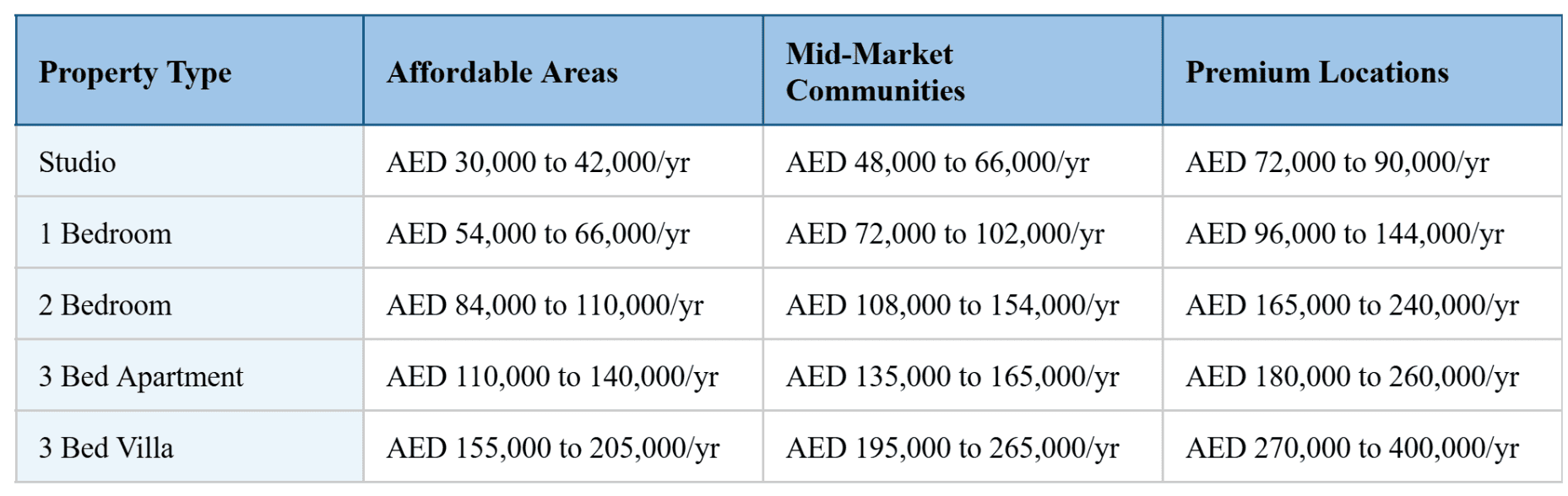
The figures below represent realistic market rates for well-maintained, unfurnished properties in early 2026. They are benchmarks, not ceilings. In areas with heavy new supply, negotiating below these ranges is increasingly achievable for tenants who do their homework.
1. Studios
The city-level average for a studio in Dubai sits at roughly AED 5,000 per month (AED 60,000 annually) in early 2026. But this figure spans a market with significant internal variation, and on its own it tells you very little.
At the budget end, areas like International City, Al Nahda, and Deira offer studios starting from AED 2,500 to AED 3,500 per month. These neighborhoods are functional, well-connected by road, and genuinely good value for renters whose priority is keeping costs down.
In the middle of the market, including JVC, Dubai Silicon Oasis (DSO), Al Furjan, and Discovery Gardens, studios typically range from AED 4,000 to AED 5,500 per month. This is where the supply surge is most visible. New buildings in JVC and DSO are competing for tenants, and that competition gives you room to negotiate.
At the premium end, studios in Dubai Marina, Business Bay, and Downtown Dubai run between AED 6,000 and AED 7,500 per month. Palm Jumeirah and DIFC sit above this, at AED 7,500 to AED 9,000 per month. The premium here is real: you are paying for walkability, Metro proximity, and a lifestyle that genuinely differs from suburban Dubai.
Tenant reality check: If you are being quoted above AED 7,000 per month for a studio that is not in a waterfront, Metro-connected, or Grade A building, verify the quote against the DLD rental calculator before agreeing to anything.
2. One-Bedroom Apartments
The average one-bedroom apartment in Dubai rents for approximately AED 7,500 per month (AED 90,000 annually) in early 2026. Again, the range around this average is wide.
Budget communities like International City, Al Nahda, and Deira offer one-bedrooms from AED 4,500 to AED 6,000 per month. These areas have seen rent pressure ease with increased supply and are genuinely undervalued relative to their connectivity.
In the mid-market tier, including JVC, DSO, Al Furjan, Mirdif, Remraam, and lower-floor or older buildings in Business Bay, one-bedrooms realistically range from AED 6,000 to AED 8,500 per month. JVC's road network, growing retail presence, and improving amenities make it a consistent tenant favourite, but supply growth means you should not pay the top of this range in a standard 2018-era building.
Premium communities like Dubai Marina, Downtown, JLT, and Dubai Hills Estate require AED 8,500 to AED 12,000 per month for one-bedrooms, with quality towers in Downtown pushing AED 130,000 to AED 150,000 annually.
3. Two-Bedroom Apartments
The two-bedroom market in Dubai averages around AED 11,500 per month (AED 138,000 annually) across the city in early 2026. Two-bedrooms are where the market's supply story is most sharply visible.
In affordable communities like JVC, DSO, Discovery Gardens, and parts of Al Furjan, two-bedrooms range from AED 7,000 to AED 9,500 per month. Developer-new buildings in these areas are being offered at competitive prices to attract initial tenants, and landlords of older stock in the same communities feel that competition directly.
Mid-market and well-connected areas, including Business Bay, Dubai Creek Harbour, Mirdif, Arjan, and Town Square, range from AED 9,500 to AED 14,000 per month, depending on building quality, floor level, and Metro proximity. Premium two-bedrooms in Dubai Marina, Downtown, JBR, and Bluewaters Island range from AED 14,000 to AED 22,000 per month, with sea-view units in newer towers sitting toward the top of this band.
4. Three-Bedroom Apartments and Villas
For three-bedroom apartments, mid-market communities like JVC, Mirdif, and Dubai Hills Estate typically range from AED 110,000 to AED 145,000 annually. Premium three-bedrooms in Downtown or Marina can reach AED 180,000 to AED 260,000 annually.
Villas are a different conversation entirely. Dubai has a well-documented shortage of ready-to-rent villas and rent-to-own across its family communities, and this supply gap has kept villa rents elevated through the broader market correction.
The Rent Increase Rules Every Tenant Must Know
Renewing a lease in Dubai without understanding the legal framework for rent increases is like negotiating a salary without knowing the industry rate.
Dubai's laws are actually quite tenant-protective but they only protect you if you invoke them.
The Dubai Land Department's Smart Rental Index is used to rate every registered building on a one to five star scale based on location, condition, and amenities. Your building's star rating directly determines its benchmark rent, meaning poorly maintained buildings are legally capped at lower amounts than well-kept ones of the same size.
Crucially, your landlord must give you 90 days' written notice of any rent increase before the renewal date. An increase announced the week before your lease expires is likely unenforceable. The practical step every tenant should take is straightforward: go to dubailand.gov.ae and use the official rental calculator before responding to any renewal notice.
If your landlord's proposed increase exceeds the legal cap, reject it in writing, cite the relevant decree, and attach the calculator output.
Where You Have Real Negotiating Power
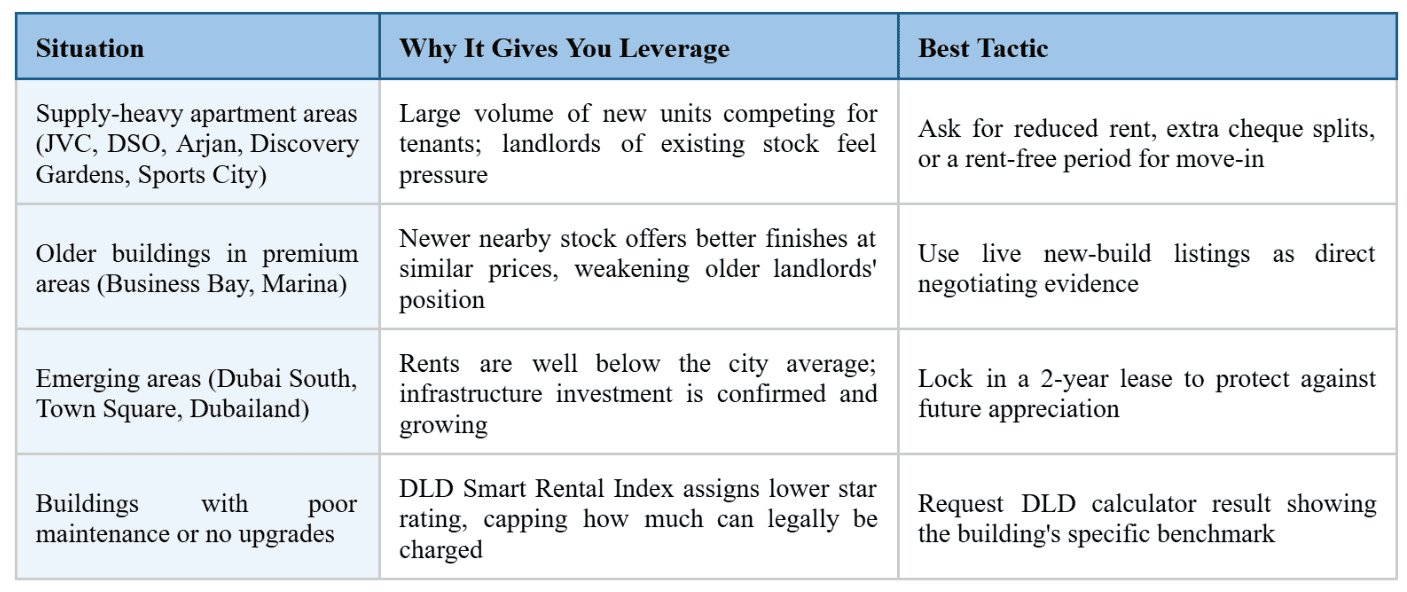
Not all parts of the Dubai rental market are equal in early 2026. The table below identifies the four situations where tenants currently hold meaningful leverage, along with the most effective tactics for each.
Tenant Leverage Map (Early 2026)
The Full Cost of Renting in Dubai: What Most Tenants Undercount
The rent you agree on is not the number that leaves your bank account each month. Several additional costs are built into the Dubai renting experience, and new tenants consistently underestimate them. The table below gives you a complete picture.
Full Monthly Cost Breakdown for Dubai Tenants
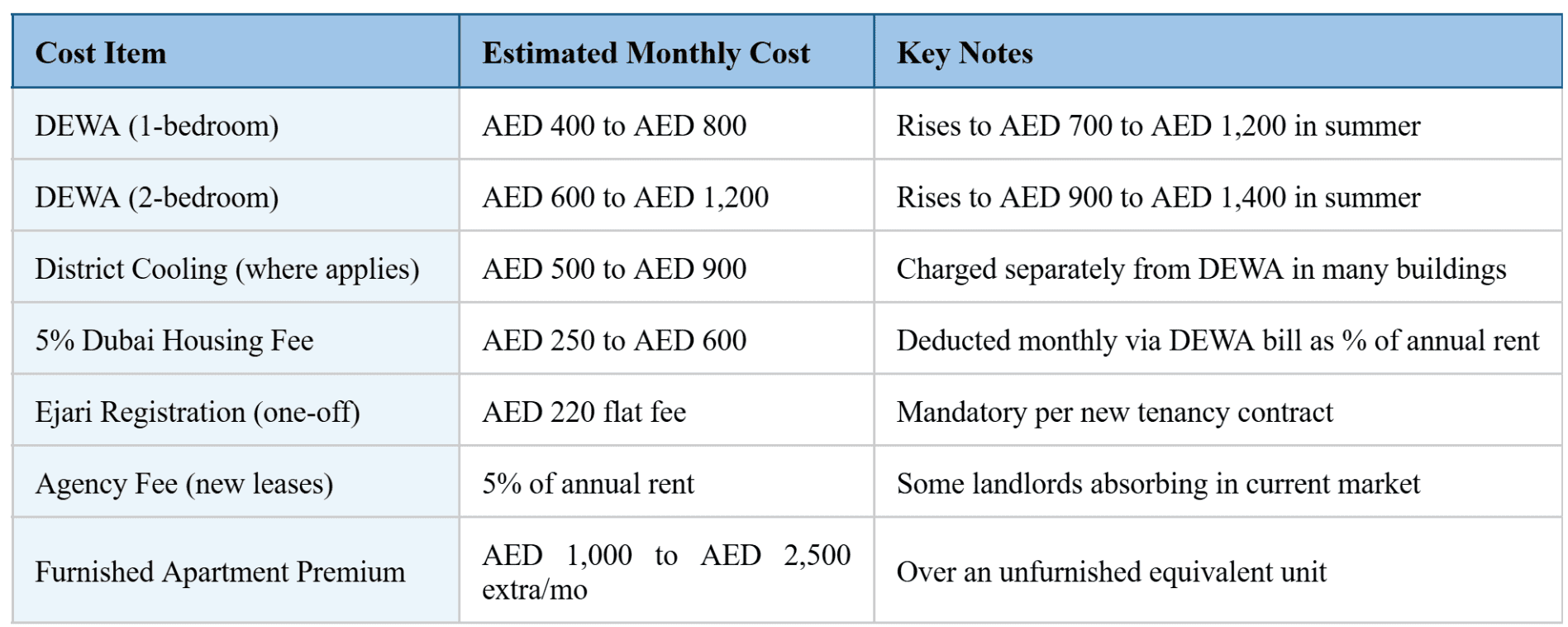
DEWA costs are estimates and vary by apartment size, floor, building insulation, and season. The 5% housing fee is calculated on annual rent and spread monthly through your DEWA bill.
Which Tenant Profiles Rent Where
Understanding who else is competing for the same properties helps you frame your own search realistically.
Young professionals and couples: Usually rent studios and one-bedrooms in Dubai Marina, JLT, Business Bay, and Downtown. These tenants prioritise Metro access, walkability, and a social environment with restaurants and leisure nearby. Competition for well-priced one-bedrooms in Dubai Marina remains strong. Speed and a clean application matter as much as price.
Families with children: They prefer square footage, proximity to good schools, green space, community feel, and vehicle access. Dubai Hills Estate, Arabian Ranches, Mirdif, and Al Furjan dominate family rental demand. A good school within a reasonable drive can be worth AED 20,000 to AED 30,000 per year in rent premium on its own.
Corporate relocations on company housing allowances: These tenants usually want furnished units with minimal setup time and central locations. If you are competing with corporate-allowance tenants for a unit in these areas, expect market-rate pricing with limited room to negotiate.
Bottom Line
Dubai's rental market in 2026 is, for the first time in several years, one where a well-informed tenant can negotiate from a position of knowledge rather than anxiety. Supply is up, growth has slowed, and the legal framework protects you more meaningfully than most tenants realise.
The preparation required is not complicated.
Remember to check the DLD calculator before every renewal discussion and understand your total cost, not just your headline rent.
The market will not do the work for you. But it will support you if you do.
Get Started With Prosper
Join owners and tenants across Dubai who manage everything in one place.